
Intelligent Real Estate Portfolio Management: Why Spreadsheets Are Putting Millions at Risk
In a large organization, the greatest risk to a real estate portfolio is rarely a vacant property. It is the lack of reliable information about it.
Imagine the following scenario.
A company is about to complete the sale of a property valued at BRL 40 million. The transaction is nearly closed when, during due diligence, an unexpected issue emerges: an official certificate expired months earlier, the contract on file was not the most recent version, and part of the documentation was stored on the computer of an employee who had already left the company.
The transaction is delayed by weeks. New costs arise. Trust between the parties begins to erode.
Situations like this occur every day in companies that manage dozens, hundreds, or thousands of properties.
The problem is not the quality of the assets. It is the way they are managed.
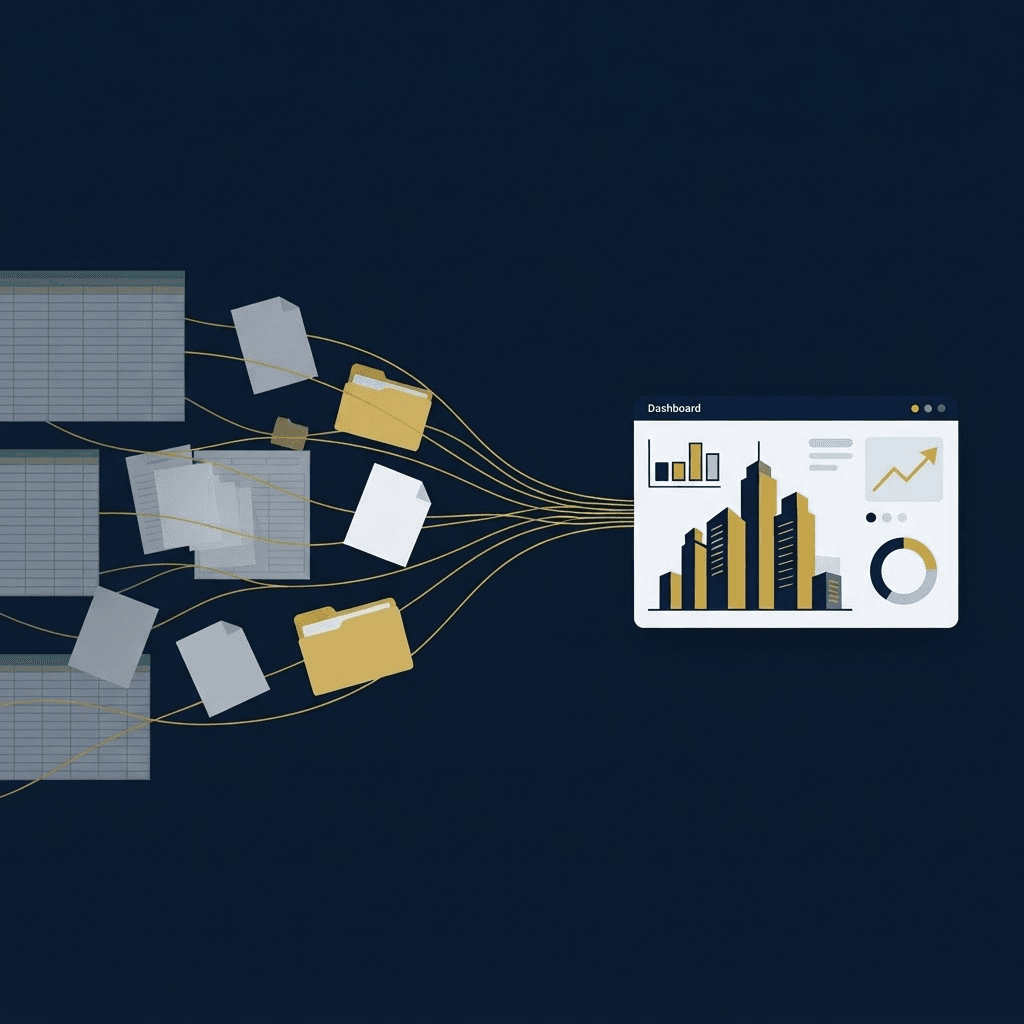
While finance teams have evolved with sophisticated ERPs and sales departments rely on intelligent CRMs, corporate real estate management still depends, in many cases, on spreadsheets, shared folders, emails, and highly manual processes.
The result is an operation that is slow, lacks transparency, and is highly vulnerable.
The good news is that this landscape is changing quickly. The combination of data centralization, automation, and artificial intelligence is redefining how large organizations manage their real estate portfolios.
The New Challenge of Corporate Real Estate Management
Real estate portfolios are no longer simply a collection of physical assets.
Today, they represent a complex combination of documents, contracts, regulatory obligations, financial indicators, legal risks, environmental licenses, certificates, guarantees, insurance policies, utility consumption, ESG data, and countless pieces of strategic information.
Each property generates hundreds of documents throughout its lifecycle.
Now imagine that scenario multiplied across 100, 500, or 5,000 properties.
The question is no longer:
"Where is the document?"
It becomes:
"Can I trust that I am looking at the right information?"
That is the real challenge of modern real estate management.
The Hidden Cost of Disorganization
When a company relies on multiple spreadsheets, shared network folders, emails, and disconnected systems, a silent problem emerges: no one has a complete view of the portfolio.
This problem usually becomes visible only when it is already too late.
The consequences are familiar to any real estate portfolio manager:
- contracts expiring without renewal;
- expired certificates;
- late payments;
- duplicate documents;
- conflicting contract versions;
- difficulties during audits;
- delays in due diligence;
- compliance risks;
- loss of institutional knowledge when employees leave the company.
In most organizations, a significant portion of the team's time is not devoted to strategic analysis.
It is spent searching for information.
When this happens across a real estate portfolio, the financial impact can be substantial.
Fragmented management
- Spreadsheets
- Emails
- Folders
- PDFs
- Isolated systems
- Manual controls
Intelligent management
- Single source of truth
- Structured documents
- Alerts
- Automation
- Artificial Intelligence
- Dashboards
- Governance
Spreadsheets Work. Until They Don't.
Every company starts with a spreadsheet.
It solves the initial problem.
Then new locations are added. More contracts. More properties. More vendors. More stakeholders. More documents.
Soon, a second spreadsheet appears. Then a third.
Before long, there are dozens of different files, each with its own owner, version, and logic.
The company ends up managing its properties through a mosaic of disconnected information.
The problem is not the spreadsheet.
The problem is using it as a management platform.
Spreadsheets were not designed to manage document lifecycles, create audit trails, automate alerts, control permissions, or integrate legal, financial, and operational data.
They simply store information.
Management requires much more than storage.
When Information Stops Being a File and Becomes Intelligence
Digital transformation in real estate management is not simply about digitizing documents.
It is about transforming scattered data into operational intelligence.
This means that every contract, property registry record, license, certificate, or document stops being a PDF lost in a folder and becomes an intelligent asset.
Imagine a platform that:
- automatically identifies critical dates;
- alerts teams to upcoming expirations;
- summarizes relevant clauses in seconds;
- identifies each party's obligations;
- flags legal risks;
- automatically connects related documents;
- detects inconsistencies between different versions.
This is no longer a vision of the future.
It is becoming the new standard expected by companies managing significant real estate portfolios.
Artificial Intelligence Changes the Game Completely
For many years, digitization was largely limited to electronic storage.
Today, we are entering a new phase.
Artificial Intelligence can interpret documents, understand legal language, identify patterns, summarize contracts, and answer complex questions across thousands of files in a matter of seconds.
Instead of manually searching through hundreds of pages for a specific clause, a manager can simply ask:
"Which contracts expire within the next 90 days?"
"Which properties have outstanding documentation?"
"Which certificates need to be renewed this quarter?"
"Which contracts contain adjustment clauses indexed to the IGP-M?"
The answer can be produced quickly.
AI is no longer just a technology tool.
It becomes an additional layer of intelligence available across the organization.
This reduces operational workload, improves the accuracy of analysis, and allows teams to focus their efforts on strategic decisions.
The Five Pillars of Intelligent Real Estate Governance
1. Single Source of Truth
All information is centralized in a single environment.
There are no multiple versions of the same document.
Everyone works from the same data foundation.
2. Document Governance
Every document has a history, version control, assigned owners, permissions, and traceability.
Audits no longer depend on manually reconstructing information.
3. Automation
Automated alerts replace controls that depend exclusively on manual follow-up.
Renewals, expirations, obligations, and outstanding items no longer rely on people's memory.
4. Data-Driven Intelligence
Reports no longer show only what happened in the past.
They help identify risks and trends and support future decisions.
Management becomes increasingly proactive.
5. Integrated Artificial Intelligence
AI does not replace specialists.
It eliminates repetitive activities and accelerates analyses that might previously have taken hours or days.
The result is a more productive team with better conditions for making informed decisions.
More Than Software: A New Way to Manage Real Estate Portfolios
True transformation does not happen simply because a company buys a new system.
It happens when the company changes the way it makes decisions.
A legal director can identify risks before they develop into larger problems.
The real estate manager gains a consolidated view of the portfolio.
Finance teams can track future obligations in advance.
Executive leadership gains access to consolidated indicators to support decisions involving expansion, sales, leasing, or investment.
Technology stops being merely operational.
It begins to influence the company's strategy directly.
How Habora Was Built to Address This Challenge
It was precisely by observing this reality that HABORA was created.
Rather than building just another system for storing documents, we developed a platform designed to transform real estate information into intelligence for decision-making.
Habora brings properties, contracts, documents, certificates, processes, obligations, indicators, and strategic information together in a single environment.
With Artificial Intelligence capabilities, the platform can support document interpretation, identify relevant information, organize data, monitor risks, and generate alerts.
The objective is simple:
- fewer spreadsheets.
- less rework.
- less risk.
- more governance.
- more productivity.
- greater confidence in decisions involving significant real estate portfolios.
The Future of Real Estate Management Has Already Begun
In the coming years, companies that continue to manage large portfolios exclusively through spreadsheets will face a growing challenge.
Not because spreadsheets will stop working.
But because the volume of data, regulatory requirements, and the speed of decision-making will demand a level of intelligence that is difficult to achieve through predominantly manual processes.
The question is no longer whether digital transformation will reach real estate management.
It already has.
The real question is:
Does your company intend to lead this transformation, or will it continue managing a real estate portfolio worth millions with tools created to solve the problems of another era?
Discover Habora
Habora is an intelligent platform for corporate real estate portfolio management.
Centralize properties, documents, contracts, certificates, and strategic information in a single environment, and use technology and Artificial Intelligence to support risk management, strengthen governance, and transform scattered data into faster, more structured decisions.
- Portfolio Management
- Legal Security
- Compliance
- Certificates
- Governance
Written by
João Gabriel FerrariManaging Partner · Founder of HABORA
João Gabriel Ferrari is an entrepreneur with over two decades of experience in corporate regularization, governance, compliance, structured management, and regulatory and corporate operations for domestic and foreign companies. He is the founder of HABORA, a real estate intelligence and management platform focused on process automation, due diligence, document management and risk control.
Specialties
- Real estate due diligence
- Governance and compliance
- Corporate regularization
- Corporate and regulatory operations
- Document management and risk control
Transform the way you manage your real estate portfolio
See how Habora can centralize information, strengthen governance, and bring intelligence to the management of your assets.