
The new governance layer for corporate real estate
HABORA connects real estate, legal, financial, operational and environmental data to turn complex portfolios into structured, auditable and actionable information.
HABORA
Real Estate Risk & Intelligence Platform
HABORA is a Brazilian technology platform built to transform the management of corporate real estate portfolios. In a single governance layer, the platform connects properties, contracts, documents, risk, financial information, due diligence, ESG, alerts, users and artificial intelligence.
Designed as a B2B SaaS platform for companies with significant real estate portfolios — retail and franchise networks, corporate groups, developers, construction companies, funds, financial institutions, asset managers and companies with distributed operations — HABORA conveys strength, enterprise vision, governance and technology, setting itself apart from real estate agencies, listing portals or conventional lease-management systems.
A large-scale market still shaped by fragmented data
Figures shown in R$ (Brazilian real).
+30.1% in volume
Real estate launches
The ABRAINC/Fipe indicators reported 30.1% growth in launched volume and 31.1% in the value of new real estate projects in 2025.
Updated: Released February 2026
+6.52% in 2025
Residential appreciation
The FipeZAP Residential Sale Index closed 2025 with cumulative appreciation of 6.52%. The average sample price was R$ 9,611 per square meter across 56 Brazilian cities.
Updated: December 2025
+9.44% in 2025
Rental market
Residential rental prices rose on average 9.44% in 2025. The average price was R$ 50.98 per square meter and the estimated average residential rental yield was 5.96% per year across the cities monitored by the index.
Updated: December 2025
R$ 107.147 billion
Economic weight of construction
Construction GDP reached R$ 107.147 billion in the first quarter of 2026. In May 2026 the sector employed 3,104,798 formally registered workers.
Updated: First quarter of 2026
The data demonstrates the economic scale of the sector. At the same time, companies with large portfolios still manage real estate information across isolated systems, spreadsheets, files, emails, disconnected ERPs and manual processes.
Scattered information, amplified risk
Corporate real estate management typically involves information scattered across:
- Contracts and amendments
- Property records and documents
- Legal obligations
- Certificates and due diligence
- Payments, adjustments and due dates
- Water, energy, gas and fuel consumption
- ESG data
- Financial systems and ERPs
- Different departments, vendors and owners
- Alerts and operational risks
Fragmentation reduces analytical capacity, increases legal and financial risk, hinders audits and prevents management from having a consolidated view of the portfolio.
An integrated layer of real estate intelligence
Key existing and planned modules, reflecting the real state of the system.
- Property management
- Contracts and documents
- Legal
- Financial
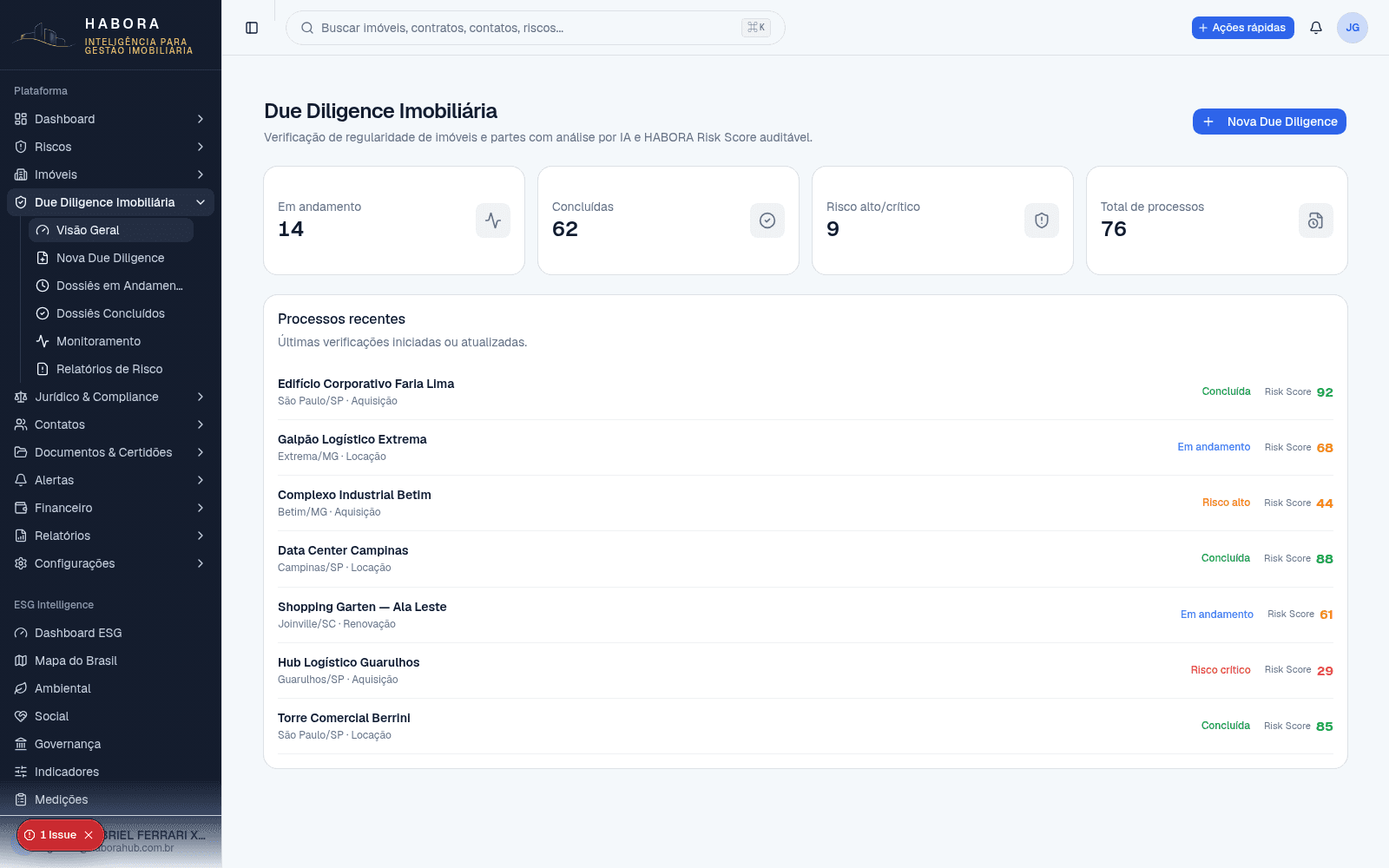
- Due Diligence
- Certificates
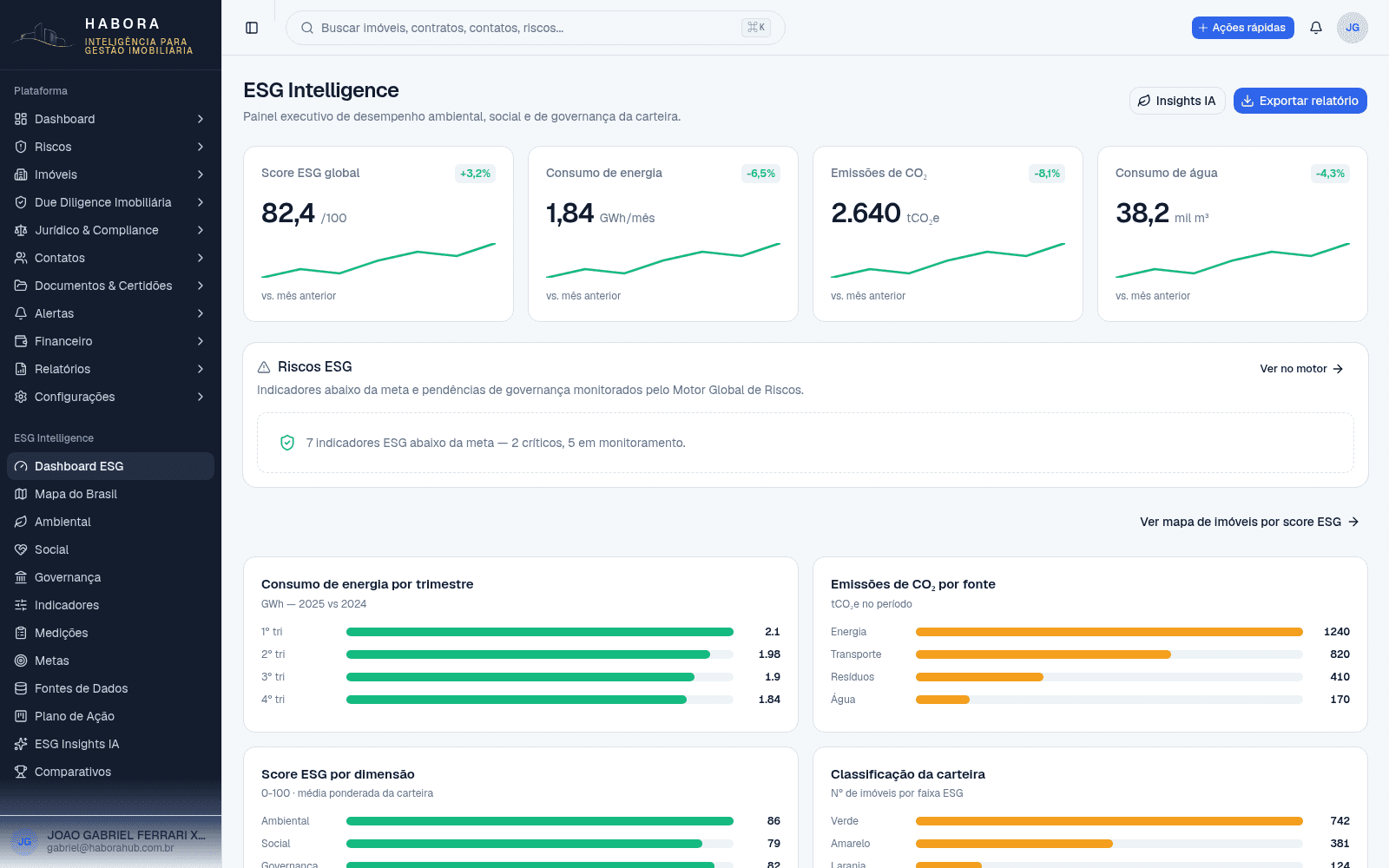
- ESG
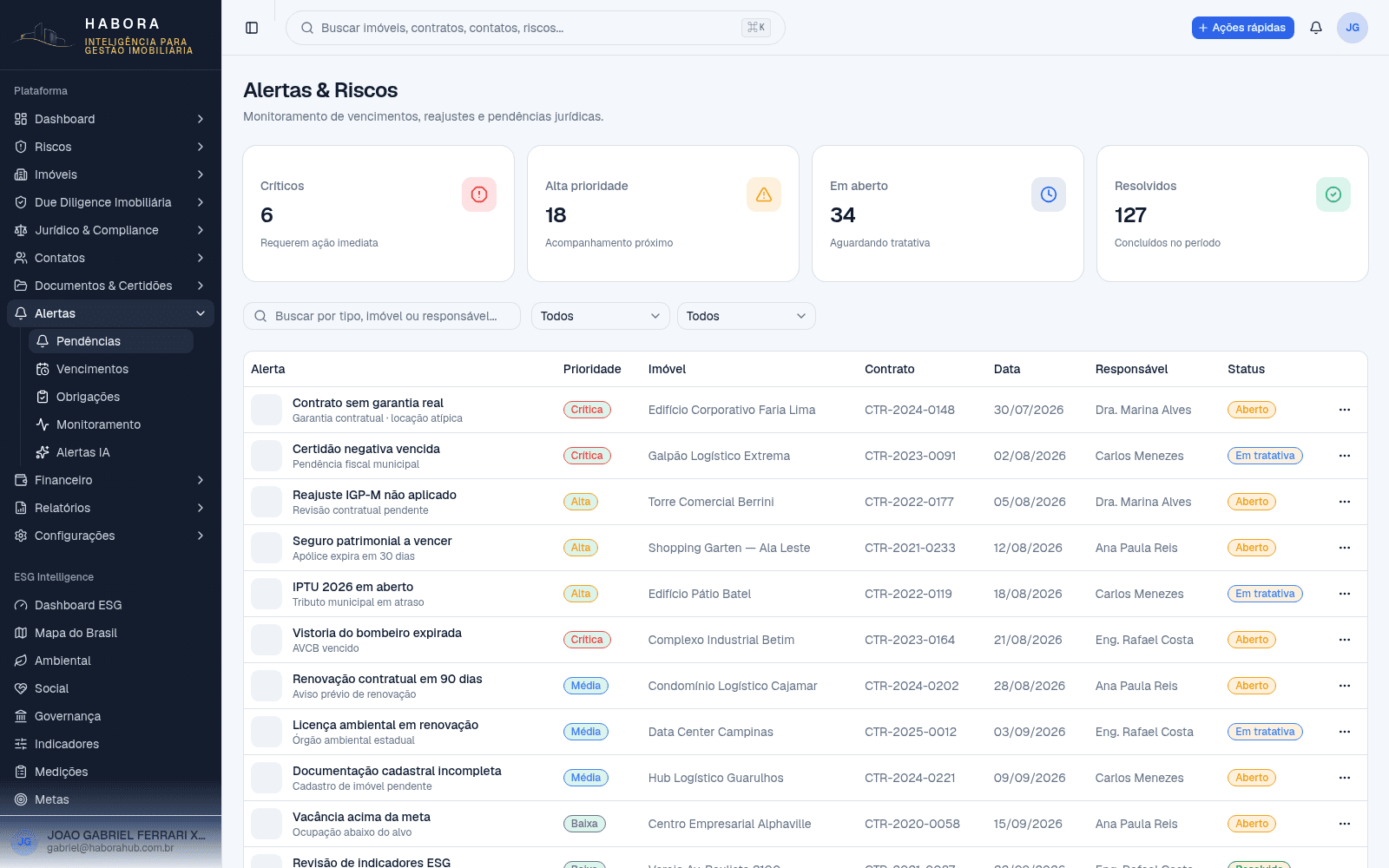
- Alerts
- Dashboards
- Reports
- Global Risk Engine
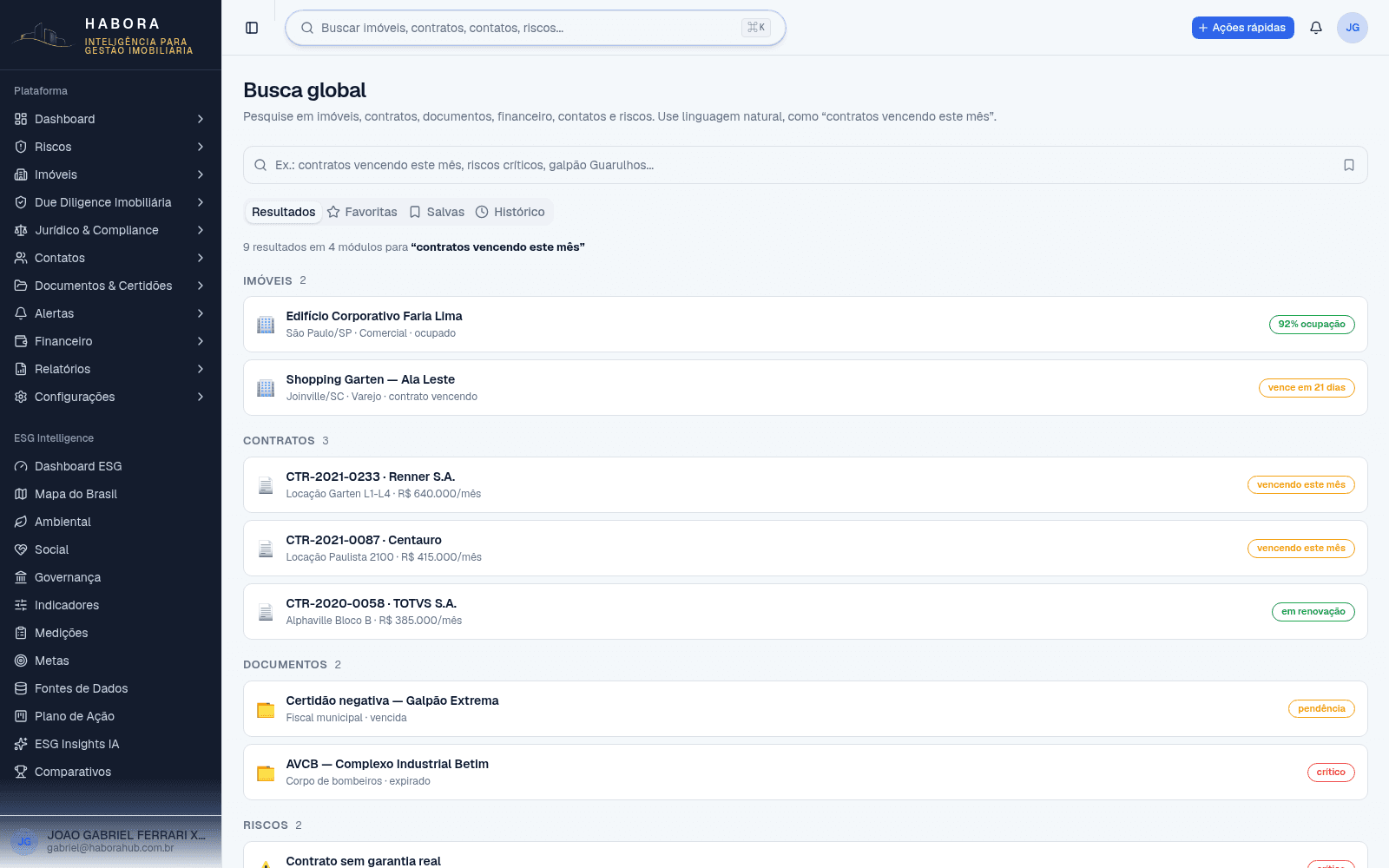
- Global Search
- Contacts
- Transactions
- Users, permissions and approval limits
- Artificial intelligence and OCR
Rather than replacing every corporate system, HABORA is architected to consolidate information, connect existing applications and deliver a unified view of risk, obligations and performance.
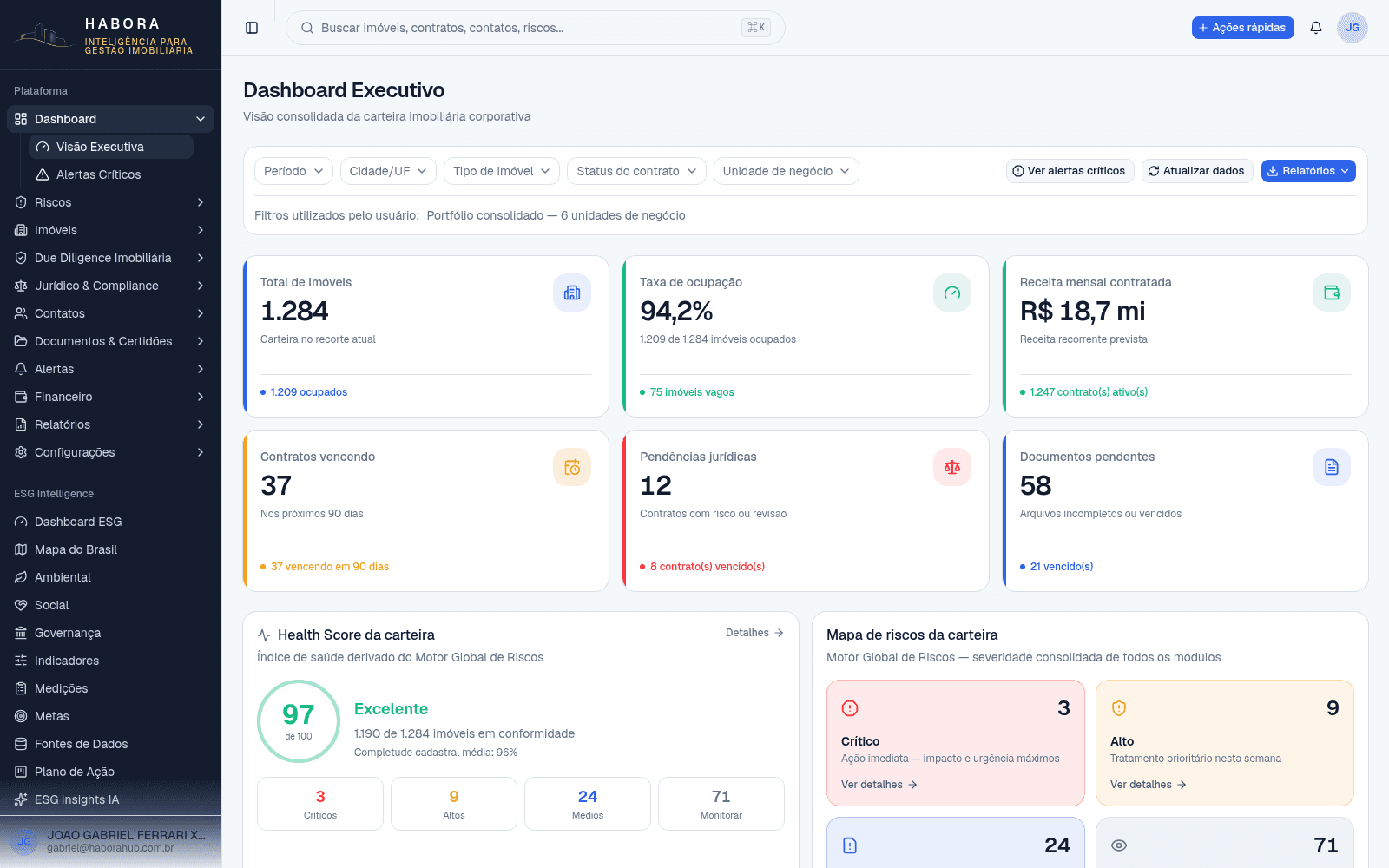
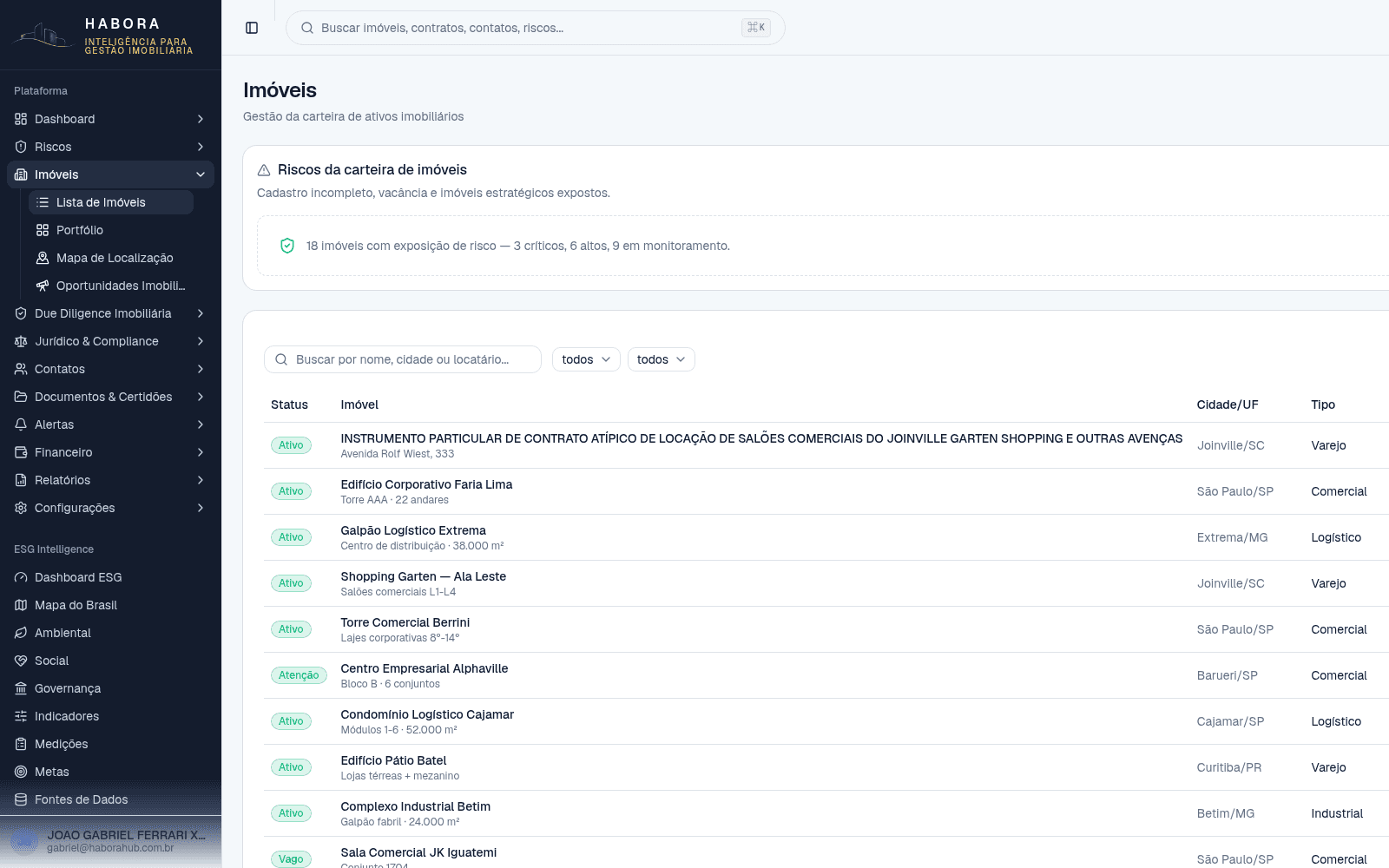
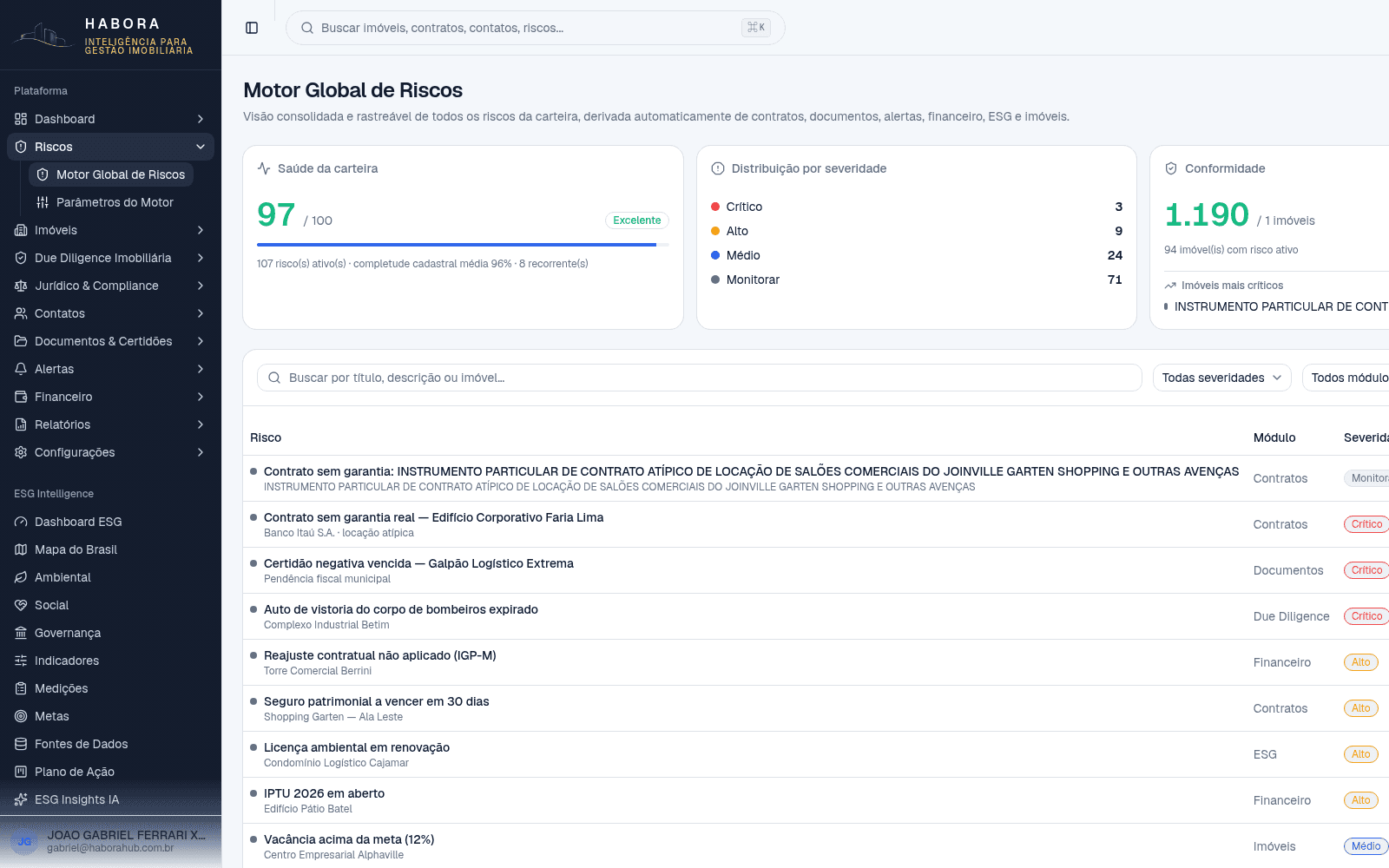
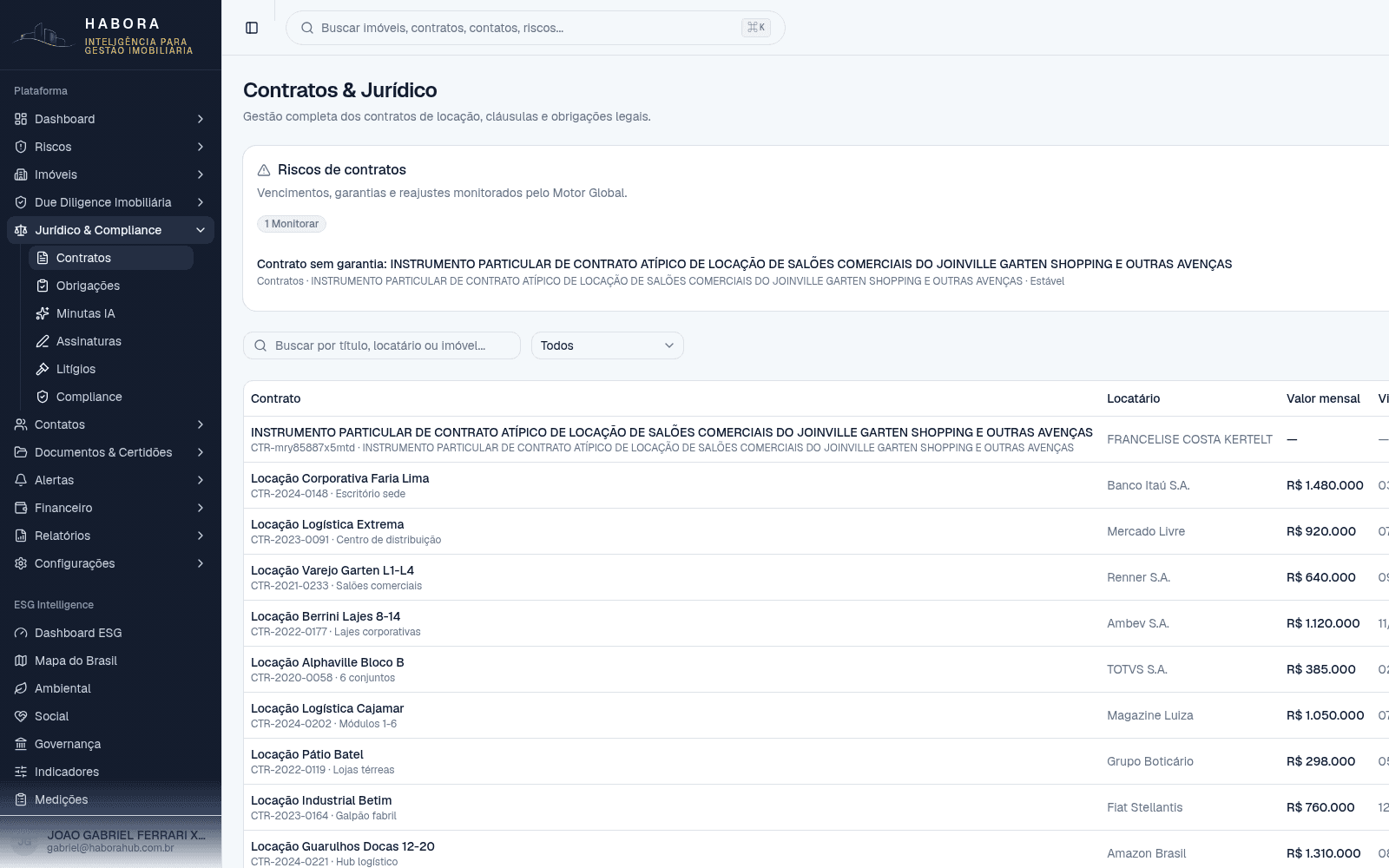
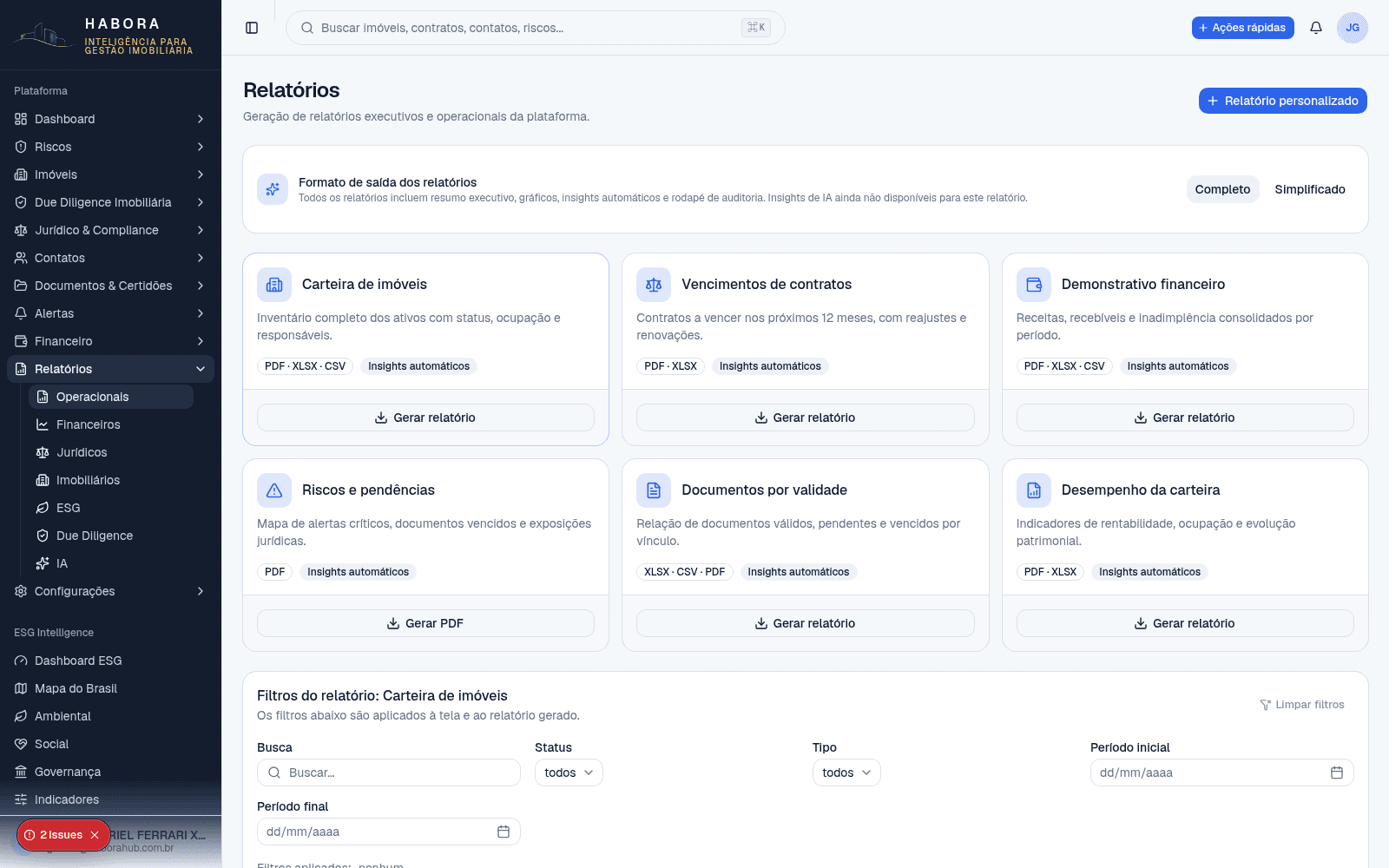
Real screens from the platform
Real screenshots from the HABORA environment, with sensitive data hidden. The images preserve the visual identity and experience of the system.
Governance embedded from the architecture
HABORA is being built with governance and security principles present from the platform's design.
The architecture uses modern web application technologies, a managed PostgreSQL database and private document storage.
- Multi-company architecture
- Logical data segregation by organization
- Mandatory company identification on every business record
- Centralized authentication
- Management of members and organizations
- Access profiles
- Role-based permissions
- Approval limits
- Principle of least privilege
- Action authorship and traceability
- Audit trails
- Change history
- Private file storage
- Centralized database
- Backups and recovery procedures
- Environment control
- Validation before production changes
- Personal data protection
- Human review of AI-generated analysis
Transparency, security and responsibility
HABORA maintains an institutional library of policies and compliance documents, architected on best practices with controls under development.
- Privacy and data protection
- LGPD (Brazilian data protection law)
- Cookies
- Information security
- Data retention and disposal
- Access control
- Business continuity
- Responsible use of the platform
- Artificial intelligence
- Editorial content
- Document management
- Responsibilities of users and organizations
Governance processes are embedded into the product, with a commitment to security, traceability and transparency. References do not imply formal certifications not yet obtained.
Artificial intelligence with human oversight
AI is used to support activities such as:
- Reading and classifying documents
- OCR
- Structured information extraction
- Clause identification
- Contract analysis
- Insight generation
- Report drafting
- Identifying inconsistencies
- Support for risk calculation and interpretation
- Consolidation of ESG indicators
Artificial intelligence acts as a support tool. Material information and legal, financial, operational or investment decisions remain subject to human validation.
A platform ready to operate within corporate ecosystems
Integrations are shown with their current state. States depend on technical confirmation and may evolve according to the roadmap.
ERPs and corporate systems
PlannedArchitecture ready to connect via APIs, structured files or import routines with systems such as:
- SAP
- Oracle
- TOTVS
- Microsoft Dynamics
- Other ERPs and corporate financial systems
Utilities and operational data
In progressThe ESG module is being prepared to receive information on electricity, water and sanitation, gas, fuel, waste, fleet and property operational data. Example sources to evaluate:
- Sabesp
- Enel
- Comgás
- Regional utilities
- Energy, water and gas providers in other Brazilian states
Where no API is available, file import and controlled manual entry are planned.
Electronic signature
PlannedIntegration or planned integration with electronic signature platforms:
- Clicksign
- DocuSign
- Doc4Sign
- Adobe Acrobat Sign
- Other providers compatible with APIs and webhooks
Planned capabilities:
- Sending documents
- Tracking the process
- Recording signatories
- Checking status
- Storing the final document
- Preserving the audit trail
ESG and international standards
PlannedAs a future direction, preparation of HABORA data for compatibility, export or integration with international references:
- GRESB
- CDP
- GRI
- International ESG disclosure and benchmarking standards applicable to real estate
This represents roadmap and future compatibility — not partnership, accreditation or completed integration. GRESB is a global ESG benchmarking and reporting reference for companies, funds, developers and real estate investors; CDP operates an independent global environmental disclosure system.
Global Risk Engine
HABORA is not limited to document storage. The Global Risk Engine was designed to:
- Identify risk events
- Consolidate legal, financial, operational, document and environmental risk
- Calculate criticality levels
- Record origin and reliability
- Manage the risk lifecycle
- Avoid duplication
- Keep history
- Consolidate risk by property and portfolio
- Provide traceability of the rules applied
The score does not constitute a credit rating, an investment recommendation or an independent audit.
Architecture for national and international growth
The multi-company, multilingual structure was designed to enable:
- Onboarding of new organizations
- Management of multiple portfolios
- Different user profiles
- Modular expansion
- Integration with external systems
- Adaptation to different regions
- Support for large portfolios
- Future internationalization
- Evolution without reliance on local processes or data stored in the browser
Leadership and origins of HABORA
João Gabriel Ferrari
Founder and CEO of HABORA
João Gabriel Ferrari has more than 20 years of business experience, having served as partner and CEO of a group specialized in supporting national and international companies in Brazil. His background spans management, governance, corporate representation, regularization, technology, corporate services and relationships with global organizations.
HABORA was born from the practical realization that companies with complex operations still struggle to consolidate real estate, legal, financial, document and environmental information into a single governance structure.
Building the intelligence infrastructure for corporate real estate
HABORA is developing a Brazilian, scalable platform ready to connect technology, governance, data and sustainability in the management of real estate assets.